
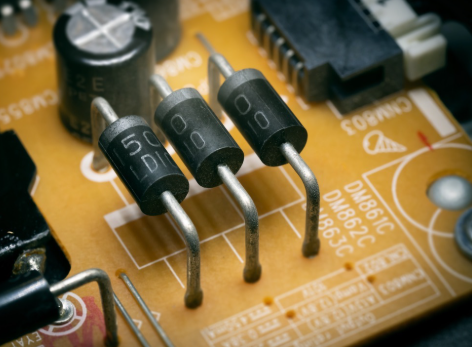
Semiconductor diodes control current direction and support power conversion processes across nearly every category of electronic and industrial equipment, making them one of the most fundamental and widely used power semiconductor components available. Understanding the different diode types, key specifications, and typical applications helps engineers and procurement teams select the right component for a given circuit rather than treating diodes as a single, interchangeable category.
This guide covers the main diode types used in power conversion, the specifications that matter most, and where each type is commonly applied.
What Do Diodes Actually Do in Power Conversion?
At a basic level, a diode allows current to flow in one direction while blocking it in the reverse direction. This simple function underlies a wide range of power conversion applications, from converting AC to DC power to protecting circuits from reverse current damage. Because this function is so foundational, diodes appear in nearly every type of power electronics system, often working alongside other components like transistors, IGBTs, and rectifiers to complete more complex power management functions.
See also: How Can Uber Drivers Avoid Taking on More Debt Than They Can Repay?
Common Types of Power Diodes
General-Purpose Rectifier Diodes
These are the most widely used diode type, designed for standard AC-to-DC conversion and general current control applications. They’re commonly used in power supplies and basic circuit protection roles where extremely high switching speed or ultra-low forward voltage isn’t a critical requirement.
Schottky Diodes
Schottky diodes are known for their lower forward voltage drop and faster switching characteristics compared to standard rectifier diodes. This makes them particularly useful in applications where efficiency losses from forward voltage drop need to be minimized, such as high-frequency switching power supplies.
Fast Recovery Diodes
Designed specifically for applications involving high switching frequencies, fast recovery diodes minimize the time needed to transition from conducting to blocking current, reducing switching losses in circuits that cycle rapidly, such as certain inverter and motor control applications.
Protection and Bypass Diodes
Used specifically for protecting circuits from reverse current or fault conditions, these diodes play a critical safety and reliability role, particularly in applications like solar PV arrays where partial shading can create reverse current conditions that risk damaging other components if left unprotected.
Key Specifications to Understand When Selecting Diodes
Forward voltage drop. Lower forward voltage drop generally means better efficiency, since less energy is lost as heat during normal conduction.
Reverse voltage rating. This determines how much reverse voltage the diode can withstand without breaking down, an important safety margin consideration for circuits with variable or unpredictable voltage conditions.
Current rating. The diode must be rated to handle the maximum forward current expected in the application, with appropriate margin for transient conditions.
Switching speed (reverse recovery time). For applications involving frequent switching, faster reverse recovery times reduce switching losses and improve overall circuit efficiency.
Thermal tolerance. Since diodes generate heat during operation, particularly under continuous load, thermal performance affects both reliability and expected component lifespan.
For buyers evaluating specific diode options, reviewing available Goodark diode products provides insight into how these specifications and diode types are typically categorized, helping narrow down suitable components based on defined application requirements rather than generic category assumptions.
Common Applications Across Industries
Diodes serve critical functions across a wide range of power conversion applications:
- Power supplies – converting AC input to stable DC output for electronic equipment
- Renewable energy systems – supporting power conversion and protecting solar arrays from reverse current and shading-related damage
- Industrial equipment – providing current control and circuit protection within larger power management systems
- Motor drives and inverters – supporting efficient switching alongside transistors and IGBTs in variable-speed and power conversion applications
- Consumer electronics – handling basic power conversion needs across countless everyday devices
Because these applications vary significantly in voltage, current, and switching speed requirements, matching diode type and specification to the actual application matters more than selecting based on general category alone.
Choosing a Reliable Diode Supplier
Component quality directly affects diode performance and reliability, particularly in applications where consistent forward voltage drop and switching characteristics matter for overall circuit efficiency. Working with an established electronic components supplier that maintains consistent manufacturing quality across its diode product range helps reduce the risk of performance variability, especially for buyers sourcing multiple diode types for different functions within the same system design.
Beyond manufacturing consistency, reliable suppliers typically provide clear documentation covering forward voltage, reverse voltage, current ratings, and thermal specifications — information that’s essential for accurate component selection rather than relying on generic category-level assumptions.
Final Thoughts
Semiconductor diodes play a foundational role in power conversion, appearing across power supplies, renewable energy systems, industrial equipment, and countless other applications. Understanding the different diode types — general-purpose rectifiers, Schottky diodes, fast recovery diodes, and protection diodes — along with the key specifications that affect performance, helps engineers and procurement teams select components that genuinely match their application’s technical requirements rather than treating diodes as a single interchangeable category.
FAQs
What is the basic function of a semiconductor diode? A diode allows current to flow in one direction while blocking it in the reverse direction, a function that underlies power conversion, current control, and circuit protection across countless applications.
What’s the difference between a standard rectifier diode and a Schottky diode? Schottky diodes offer lower forward voltage drop and faster switching compared to standard rectifier diodes, making them better suited to high-frequency, efficiency-sensitive applications.
Why do fast recovery diodes matter in switching applications? They minimize the time needed to transition between conducting and blocking current, reducing switching losses in circuits that operate at high switching frequencies.
What specifications matter most when selecting a diode? Key specifications include forward voltage drop, reverse voltage rating, current rating, switching speed, and thermal tolerance, all of which should be matched to the specific application’s requirements.
Why is diode selection important in renewable energy systems? Diodes support power conversion and protect solar arrays from reverse current caused by partial shading, making proper specification important for both efficiency and long-term system reliability.




 Why Discount Mini-Splits Are Becoming the Go-To Heating & Cooling Solution for Small Spaces