
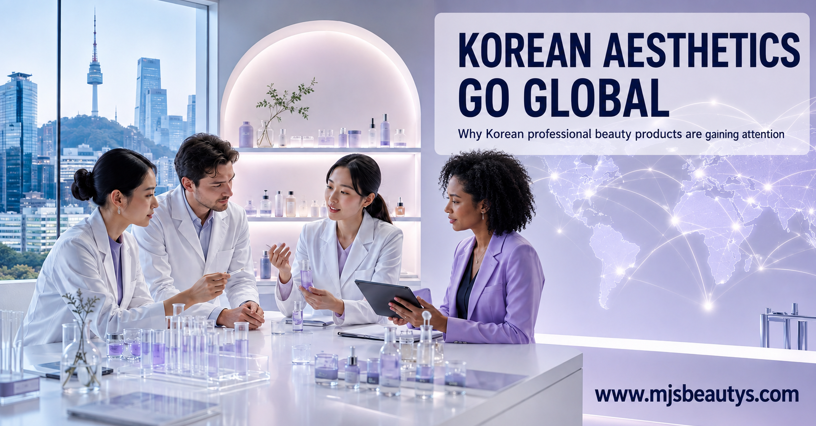
Product diversity, fast-moving formulation trends and an export-oriented beauty industry have made South Korea an important market to watch.
From Consumer Beauty to Professional Aesthetics
South Korea’s influence on global beauty is often associated with skincare routines, lightweight textures and rapid product launches. In recent years, attention has also expanded toward professional aesthetic products. Clinics and distributors outside Korea are increasingly familiar with Korean brands across injectable skincare, hyaluronic-acid gels, post-procedure products and aesthetic equipment.
The growth is not driven by a single product. It reflects an ecosystem of manufacturers, ingredient suppliers, packaging specialists and export partners that can develop and distribute highly segmented ranges. That segmentation appeals to professional buyers who want products organized around different treatment goals and price points.
A Broad Approach to Skin Quality
One of the most visible areas is the Korean Skin Booster category. Rather than representing one formula, the category covers a wide spectrum of products associated with hydration, texture and overall skin-quality protocols. Depending on the product, formulations may feature non-cross-linked hyaluronic acid, PN or PDRN, peptides, exosome-related ingredients or multi-component solutions.
This variety mirrors a broader Korean beauty philosophy that treats skin condition as a continuing process rather than a single corrective event. In the professional market, that idea has translated into products designed for planned sessions, combination protocols and different areas of concern.
International buyers still need to examine each item separately. A shared category name does not guarantee the same ingredients, concentration, preparation method or regulatory status. Product documentation and the rules of the destination market remain essential.
Hyaluronic-Acid Fillers Remain a Major Export Segment
The Korean Dermal Filler market is another reason for growing international attention. Korean manufacturers offer numerous HA gel families with variants designed around different depths, tissue characteristics and contouring objectives. Product lines may differ in HA concentration, cross-linking technology, gel firmness, syringe presentation and the inclusion of lidocaine.
For clinics, a broad range can make it easier to compare options. It can also create confusion when similar product names or packaging obscure meaningful differences. Professional purchasing requires more than choosing the lowest price. Buyers must verify the exact model, manufacturer, packaging, storage requirements and intended professional use.
The most useful market trend is therefore not simply that more products exist. It is that buyers are becoming more technically literate. Specifications, traceability and training increasingly shape purchasing decisions alongside brand awareness.
Why the Market Moves Quickly
Korean beauty companies operate in a highly competitive environment where consumers and professionals respond quickly to new formats and ingredients. Manufacturers often develop multiple variants within one range, update packaging and expand into adjacent categories. Digital commerce and international trade events help these launches reach overseas buyers faster than in the past.
Social media also plays a role, but it can compress complicated professional products into short trend labels. A viral ingredient does not automatically make every formulation equivalent or appropriate. The faster information travels, the more important it becomes for professionals to separate a product’s technical documentation from promotional content.
Global Growth Brings Greater Responsibility
As Korean aesthetic products reach more markets, responsibility is shared across the supply chain. Manufacturers must provide consistent documentation and packaging. Distributors need reliable sourcing and storage. Clinics must confirm that products are permitted in their jurisdiction and used only by appropriately qualified professionals.
- Verify the manufacturer and exact product variant.
- Check local import, registration and professional-use requirements.
- Confirm lot, expiry and packaging integrity.
- Follow stated storage and preparation instructions.
- Avoid making claims that exceed the product documentation.
A Trend With Long-Term Significance
Korea’s professional aesthetic sector is likely to remain influential because it combines manufacturing capacity with a strong culture of beauty innovation. Its international growth also shows how the market is changing: buyers want more specialized choices, but they also expect clearer information and stronger supply-chain controls.
The next stage of growth will depend less on novelty alone and more on trust. Brands and distributors that make technical specifications easy to understand, maintain traceability and support responsible professional use will be better positioned as global interest continues.
Publisher Link Map — Not for Publication
The phrases below appear in bold in the manuscript. Add the stated URL to the exact anchor text during publication. No hyperlinks are embedded in this document.



 Looking for a Soul App Alternative? Here’s What Voice Social Users Should Know