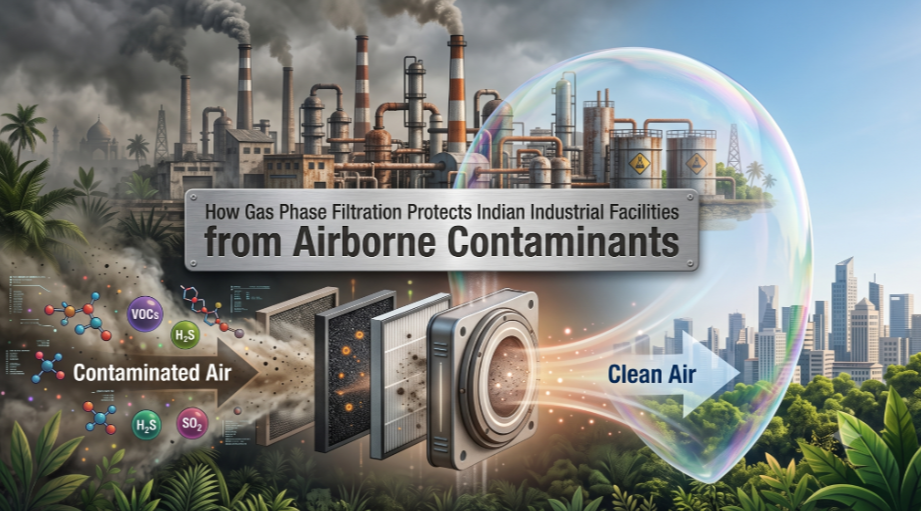
Indian industrial facilities can face a wide range of airborne gaseous contaminants, from volatile organic compounds (VOCs) and process fumes to corrosive gases, ozone, and persistent odors. Unlike particulate pollutants, these contaminants may pass through conventional particle filtration because they exist as gases or vapors.
This is where Gas Phase Filtration becomes important. By using specially selected sorbent media and chemical treatment mechanisms, gas phase filtration systems can capture or react with targeted gaseous contaminants before they damage equipment, affect indoor environments, or interfere with sensitive industrial processes.
For facility managers, MEP consultants, engineers, and technical decision-makers, selecting the right Gas-phase air filtration approach requires understanding the contaminant, its concentration, the operating environment, and the chemistry of the filtration media.
What Is Gas Phase Filtration?
Gas Phase Filtration is an air-cleaning technology designed to remove gaseous contaminants and vapors from an air stream through physical adsorption, chemical reaction, or a combination of both.
Instead of primarily capturing solid particles, molecular filtration targets contaminants at the molecular level. The filtration media may contain activated carbon, impregnated carbon, alumina-based media, or other chemically treated sorbents selected according to the contaminants present.
The basic process can be understood in three stages:
- Contaminated air enters the filtration system.
- Gaseous contaminants interact with the sorbent or chemically treated media.
- Target contaminants are adsorbed or chemically converted, reducing their concentration in the treated air.
The effectiveness of a system depends heavily on correct media selection and application-specific design. A media that performs well against one contaminant may not be appropriate for another.
Why Do Indian Industrial Facilities Need Molecular Filtration?
Industrial air quality problems are not limited to dust and particulate matter. Many facilities generate or are exposed to gases and vapors that can create operational, environmental, odor, or equipment-related problems.
Examples include:
- VOCs from solvents, coatings, adhesives, and manufacturing processes
- Corrosive gases in industrial and electronic environments
- Odorous compounds from chemical and biological processes
- Ozone entering sensitive environments from outdoor air
- Acidic or alkaline gases generated by specific industrial operations
- Process-related fumes and vapors
- Chemical contaminants that can affect sensitive equipment
In facilities containing electronics, control systems, precision instruments, or sensitive manufacturing equipment, even relatively low concentrations of corrosive contaminants can become an operational concern over time.
For this reason, Industrial Air Quality management should consider both particulate and gaseous contaminants where the facility’s processes and environment warrant it.
How Does Gas Phase Filtration Remove Gaseous Contaminants?
Gas phase filtration generally relies on two major mechanisms: adsorption and chemisorption.
Adsorption
Adsorption occurs when gas molecules adhere to the surface of a porous material.
Activated carbon is widely used because its highly porous structure provides a large internal surface area where certain gaseous molecules can be retained.
Physical adsorption can be influenced by several factors, including:
- Contaminant chemistry
- Molecular size and polarity
- Media characteristics
- Temperature
- Relative humidity
- Contaminant concentration
- Airflow and contact conditions
- Quantity and configuration of media
Therefore, simply specifying “activated carbon” is not enough to determine whether a system will be suitable for a particular application.
Chemisorption
Chemisorption involves a chemical reaction between the contaminant and a chemically active component within the filtration media.
Impregnated carbon and certain alumina-based media can be engineered to react with specific classes of gaseous contaminants.
This mechanism is particularly relevant when dealing with reactive or corrosive gases for which ordinary physical adsorption may not provide the desired treatment.
The selection between adsorption, chemisorption, or a combination of media should be based on the actual contaminant profile rather than a generic filtration specification.
What Role Does Activated Carbon Play?
Activated carbon is one of the most established sorbent materials used in molecular filtration.
Its porous structure allows certain gas molecules to be attracted to and retained on internal surfaces. It can be useful for applications involving many VOCs, odors, and other organic contaminants.
However, activated carbon is not a universal solution.
Its performance can vary substantially depending on the contaminant and operating conditions. Humidity, temperature, contaminant concentration, competing gases, and media characteristics can all influence adsorption behavior.
For example, a facility dealing primarily with VOCs may require a different carbon formulation or media configuration than a facility concerned with reactive acidic or alkaline gases.
When Is Impregnated Carbon Used?
Impregnated carbon contains additional chemical agents intended to improve its ability to react with particular gaseous contaminants.
This makes it useful in applications where chemisorption is more appropriate than relying solely on physical adsorption.
The impregnation chemistry must match the target contaminant. Therefore, media selection should be based on contaminant identification and application requirements rather than simply choosing the highest quantity of carbon.
How Does Gas Phase Filtration Help Control VOCs and Odors?
VOCs are gaseous organic compounds that can originate from solvents, paints, coatings, adhesives, fuels, cleaning products, manufacturing processes, and other sources.
Depending on the compound and concentration, VOCs may contribute to odors and undesirable indoor air conditions.
Activated carbon and other sorbent media can be used to capture suitable VOCs through adsorption. However, different VOCs have different physical and chemical characteristics, so media suitability must be evaluated for the actual contaminant mixture.
Odor control presents a similar challenge.
An odor is not necessarily a single contaminant. It can result from a mixture of compounds, sometimes at very low concentrations. Effective odor-control design therefore starts with identifying the source and chemical composition wherever possible.
For facilities such as hotels, healthcare environments, food-processing areas, laboratories, manufacturing plants, and commercial buildings, source control and adequate ventilation remain important. Molecular filtration can be considered when gaseous contaminants or odors need additional treatment.
How Can Gas Phase Filtration Address Corrosive Gases?
Corrosive gases deserve particular attention in facilities containing sensitive electronics, electrical control systems, instrumentation, or precision equipment.
Potential sources can include industrial processes, chemical storage, nearby emissions, combustion-related pollutants, and outdoor air entering a facility.
Certain gases can react with moisture and form corrosive compounds on sensitive surfaces. Over time, this can contribute to corrosion of electronic components, contacts, connectors, and other vulnerable materials.
Gas phase filtration can help by targeting specific gaseous contaminants before they reach sensitive areas.
Depending on the contaminant, systems may use activated carbon, impregnated carbon, alumina-based media, or combinations of chemically treated sorbents.
The important point is that corrosive gas filtration is a chemistry-specific application. The system should be designed around the gases actually present rather than based on a generic “corrosion filter” specification.
Which Industries Can Benefit from Gas Phase Filtration?
Gas Phase Filtration can be relevant across many Indian industrial and commercial environments where gaseous contaminants create an identifiable air-quality challenge.
| Facility / Industry | Potential Contaminant Concern |
| Pharmaceutical manufacturing | Solvents, process vapors, VOCs |
| Chemical industries | Reactive and corrosive gases |
| Automobile and engineering | Solvent vapors, VOCs, process emissions |
| Laboratories | Chemical vapors and specific gaseous contaminants |
| Hospitals and healthcare facilities | Odors, VOCs, and selected gaseous contaminants |
| Food-processing facilities | Odors and process-related vapors |
| Textile industries | VOCs, process chemicals, and odors |
| Electronics and control rooms | Corrosive gaseous contaminants |
| Manufacturing plants | Process gases, VOCs, and odors |
| Hotels and banquets | Odors and selected VOCs |
| Educational institutions | Indoor gaseous contaminants depending on building conditions |
| Commercial buildings | Outdoor gaseous pollutants and VOCs |
The exact filtration approach should always be determined by the facility’s contaminant sources, operating conditions, air volume, and required treatment objectives.
What Should Engineers Consider Before Selecting a Gas Phase Filter?
Choosing a molecular filtration system should begin with the contaminant, not the filter.
1. Identify the Contaminants
Determine which gases or vapors are present. Where necessary, use available process information, environmental assessments, or appropriate air-quality testing.
Knowing whether the problem involves VOCs, acidic gases, alkaline gases, ozone, odors, or multiple contaminants can significantly influence media selection.
2. Consider Concentration and Exposure
The concentration of a contaminant affects the required media and system design.
A system intended for low-level background contamination may be designed differently from one exposed to a continuous process emission.
3. Evaluate Relative Humidity
Moisture can affect the performance of certain sorbent materials and chemical reactions.
Indian operating environments can experience substantial variations in temperature and humidity, making environmental conditions an important design consideration.
4. Assess Airflow Requirements
The required airflow influences filter dimensions, media quantity, contact conditions, and overall system configuration.
The filtration system should be evaluated at the actual operating airflow rather than relying solely on nominal filter descriptions.
5. Consider Competing Contaminants
Real-world industrial air rarely contains just one gas.
Multiple contaminants may compete for available adsorption sites or interact with the filtration chemistry. This is why a contaminant profile is often more useful than selecting media based on one isolated gas.
6. Plan for Media Replacement
Gas phase media has a finite contaminant-holding or reaction capacity.
Once media becomes loaded or chemically exhausted, its performance can decline. A practical system design should therefore consider inspection, monitoring where appropriate, access for replacement, and safe handling of spent media.
Is Gas Phase Filtration the Same as Particulate Filtration?
No. The two technologies address different types of airborne contaminants.
Particulate filters are designed primarily to capture particles such as dust, fibres, aerosols, and other suspended matter.
Gas phase filtration is designed to address gaseous contaminants and vapors through adsorption and/or chemical reaction.
In some applications, both types of air treatment may be required because the air stream contains both particulate and gaseous pollutants. However, their functions and selection criteria should not be confused.
The appropriate solution depends on the contaminant profile and the specific objective of the facility.
How Can Facilities Improve Gas-Phase Filtration Performance?
A filtration system is only as effective as its application and maintenance strategy.
Facility managers should consider:
- Identifying contaminant sources before selecting media
- Selecting media based on contaminant chemistry
- Operating the system at its intended airflow
- Monitoring relevant environmental conditions
- Inspecting media condition according to the system’s maintenance requirements
- Establishing a planned media replacement strategy
- Investigating unexpected odor or contamination increases
- Preventing unnecessary bypass around the filtration system
- Reviewing changes in industrial processes that could alter contaminant loading
For critical environments, monitoring can also provide useful information about changing contamination conditions and help determine when further investigation or maintenance is required.
Frequently Asked Questions
What is Gas Phase Filtration used for?
Gas Phase Filtration is used to remove or reduce targeted gaseous contaminants and vapors, including suitable VOCs, odors, ozone, and certain corrosive or reactive gases.
Does activated carbon remove all gases?
No. Activated carbon is not a universal gas-removal medium. Its suitability depends on the contaminant’s properties, operating conditions, humidity, concentration, and the characteristics of the carbon.
What is the difference between adsorption and chemisorption?
Adsorption generally involves gas molecules being retained on the surface of a material, while chemisorption involves a chemical reaction between the contaminant and an active component of the media.
Can gas phase filtration control industrial odors?
It can help control suitable odor-causing compounds when the correct media is selected. Because odors can result from complex mixtures, identifying the odor source and compounds involved is important before selecting a filtration system.
How often should gas phase filter media be replaced?
There is no universal replacement interval. Media life depends on contaminant concentration, airflow, humidity, media quantity, contaminant chemistry, and operating conditions. Replacement should therefore be based on application-specific assessment and appropriate monitoring or maintenance criteria.
Is gas phase filtration useful for corrosive gases?
Yes, appropriately selected molecular filtration media can be used to target certain corrosive gases. The media chemistry must be matched to the contaminants and the operating environment.
Key Takeaways for Indian Facilities
Gas Phase Filtration provides a practical method for addressing airborne gaseous contaminants that conventional particulate filtration is not designed to remove.
The most important principles are:
- Start with the contaminant. Identify the gases, vapors, and odors that need to be controlled.
- Select media according to chemistry. Activated carbon, impregnated carbon, and alumina-based media have different applications.
- Understand the difference between adsorption and chemisorption.
- Account for humidity, temperature, airflow, concentration, and competing contaminants.
- Treat corrosive-gas control as an application-specific engineering problem.
- Plan for inspection and media replacement rather than assuming unlimited filter life.
- Consider the complete facility environment and contaminant sources before specifying a system.
For Indian pharmaceutical, chemical, manufacturing, healthcare, laboratory, electronics, commercial, and other facilities dealing with gaseous contaminants, the right gas phase air filtration strategy can provide an important layer of protection for indoor air quality, sensitive equipment, and facility operations.
If your facility is experiencing VOC, odor, corrosive-gas, or other molecular contamination concerns, a contaminant-specific assessment can help determine the appropriate media and filtration configuration. Synergy Air Systems can evaluate the application and recommend a Gas Phase Filtration approach based on the facility’s actual requirements rather than relying on a one-size-fits-all solution.