
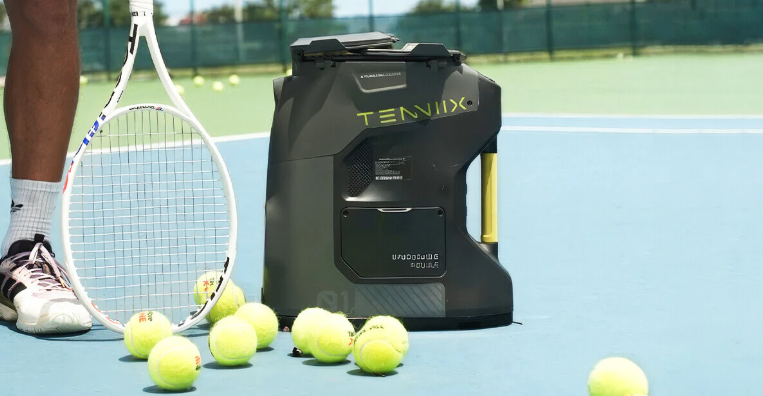
Most tennis training equipment shares one fundamental limitation: it stays in place. Ball machines feed shots from a fixed position, and even vision-based systems that track player movement are ultimately anchored to one spot on the court. That limitation shapes the entire training experience, restricting practice to drills that work around a stationary feeder rather than reflecting how tennis is actually played. Mobility is the next logical step in solving that problem, and it’s exactly where the Tenniix Ultra is positioned.
Why Stationary Machines Have a Ceiling
Even the most advanced fixed-position machines can only simulate so much. They can adjust speed, spin, and shot placement, and vision-based systems can track a player’s position to inform feed timing — but the ball itself always originates from the same physical location. That’s fundamentally different from playing against a real opponent, whose position on the court is constantly shifting.
This matters more than it might initially seem. A significant part of tennis is reading and reacting to where shots are coming from, not just where they’re going. Training exclusively against a fixed-position feeder, no matter how intelligent, leaves a gap in developing that specific skill.
See also: Best Safety Glasses for Work and Outdoor Tasks in 2026
Adding Mobility to the Equation
The mobile AI tennis robot addresses this directly by introducing an omnidirectional mobility module built on top of the existing Pro training platform. Rather than remaining fixed, the system can move sideways, backward, and diagonally — changing the physical origin point of shots throughout a session rather than just varying speed and placement from one spot.
Combined with AI vision that follows play in real time, this creates a training experience that’s structurally different from anything a stationary machine can offer. The machine isn’t just reacting to the player — it’s repositioning itself the way an actual opponent would, which fundamentally changes what kinds of drills and simulations become possible.
What Dynamic Positioning Actually Enables
Mobility unlocks training scenarios that simply aren’t possible with fixed-position equipment:
Varied court angles. Shots can originate from different physical positions across the court, forcing players to read shot origin rather than anticipating from a single fixed point.
More realistic opponent simulation. Because the machine can reposition between shots, sequences can mimic how a real opponent might move to construct a point, rather than simulating movement purely through feed variation.
Dynamic full-court drills. Training that requires responding to genuinely unpredictable positioning — rather than predictable feed patterns from a stationary source — becomes possible in a way that better reflects live match conditions.
For competitive players specifically, this closes one of the more persistent gaps in solo training: the inability to practice against something that moves and repositions the way an actual opponent does.
Extending Capability Through the Vision System
Much of what makes this level of dynamic training possible comes down to the underlying vision and sensing system, which shares its foundation with modules available as standalone upgrades. The AI Vision Module, for example, adds tracking and advanced training functions to compatible systems, reflecting the same core technology that enables the Ultra’s more advanced positioning and opponent-simulation features.
This connection matters for players thinking about long-term investment. Understanding how vision and tracking capability scales across the product lineup — from add-on modules to a fully mobile platform — helps clarify where a mobile system like the Ultra fits for players who eventually want the most realistic full-court training available.
Who This Is Actually Built For
A mobile training robot represents a significant step up in both capability and complexity, and it’s not necessarily the right starting point for every player. It’s best suited for:
- Competitive and tournament-level players who need training that closely mirrors the unpredictability of live match play
- Players focused on court coverage and positioning rather than purely shot mechanics
- Coaches looking to supplement structured lessons with dynamic, opponent-style simulation during individual practice time
Players still building foundational consistency are generally better served starting with simpler, fixed-position training before advancing to a system built around full-court dynamic movement.
The Broader Direction This Points Toward
Mobility represents a meaningful shift in how solo training equipment is evolving. As vision and sensing technology continues to mature, the gap between “practicing against a machine” and “practicing against something that moves and responds like an opponent” keeps narrowing. This kind of platform reflects where independent training is heading — not just smarter fixed equipment, but genuinely dynamic systems that adapt their physical positioning, not only their output.
Final Thoughts
Stationary training machines, however intelligent, share a structural limitation that mobility directly addresses. By combining omnidirectional movement with AI vision tracking, dynamic training systems create practice conditions that more closely resemble live match play — a meaningful step forward for competitive players looking to close the gap between solo practice and real opponent training.
FAQs
1. What makes a mobile training robot different from a stationary machine? A mobile system can physically reposition itself around the court, changing the origin point of shots, rather than remaining fixed in one location like traditional machines.
2. Who benefits most from a mobile training system? Competitive and tournament-level players focused on court coverage, positioning, and realistic opponent simulation tend to benefit most from this type of equipment.
3. Is mobility necessary for beginners? Not typically. Beginners generally benefit more from simpler, fixed-position training that focuses on building consistent fundamentals before advancing to dynamic, full-court systems.
4. How does AI vision tracking relate to mobility features? Vision-based tracking allows the system to follow player movement and adjust positioning accordingly, forming the technical foundation that enables realistic opponent-style simulation.
5. Can vision and tracking capabilities be added to other machines? Some standalone modules add tracking and advanced training functions to compatible systems, offering a partial upgrade path for players not yet ready for a fully mobile platform.

 Planning the Best Villa Renovations in Dubai: Key Factors to Consider